
 Automotive & Recreation Batteries
  Charging & Power Conversion
  Device & Everyday Batteries
  Bluetti
  Accessories & Installation
  Offgrid Systems
  Power & Conversion
  Batteries & Accessories
  Accessories & Installation
  Accessories & Installation
  Charging & Power
  Systems & Packages
  Batteries
  Bluetti
  Starlink
  Dual Battery Systems & Packages
  Batteries
  UHF
UHF  Bluetti
  Lighting
  Brake Controllers
  Accessories & Installation
  Charging & Power
  Coverage & Handsfree
  Starlink
 Solar Basics: Choosing the Right Panels
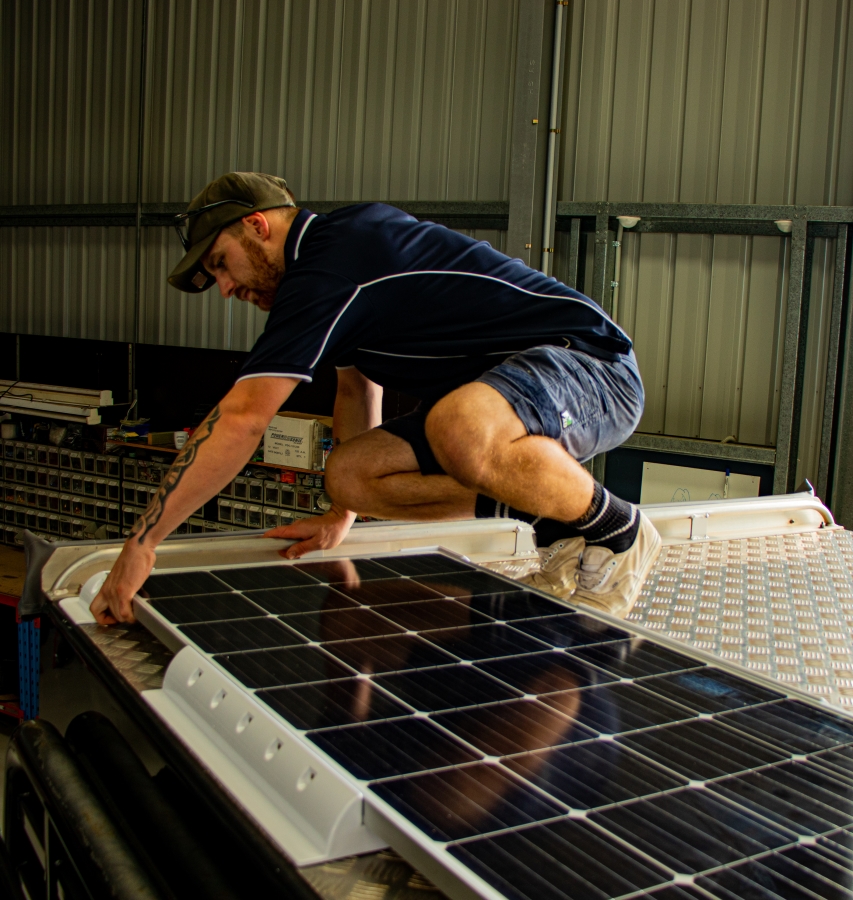
Clean energy is the future. We are seeing more and more companies beginning to adopt green options and the technology fuelling this technology is growing by the day. As such, now is a perfect time to get into solar! With that said, navigating the world of solar technology can be difficult at this point, with so many different options and having to calculate your needs and usage, not just now, but for the future. Fear not, we’re here to help! This is the first instalment of a greater series that we are going to be putting out regarding the basic components of solar, things you will need to know for organising your first solar setup, and some useful tips to help optimise your build!
The basics of solar
There are so many solar panels available on the market at this point, made to suit any situation and any individuals needs, but in order to find the ones that are right for you, a few things to look out for are size of the panels, as well as wattage.
If you’re looking at mounting your solar panels on the roof, which would be fairly standard at this point, you will obviously need to find a panel that will fit your roof’s footprint. In general, it is a requirement that your panels are 50cm or more away from the edge of your roof, so bear this in mind and calculate your sizing accordingly! Depending on the height of your house as well, you may need to put some though towards the maximum height levels of your solar panel mounting options.
There should also be consideration put towards the placement and direction of your panels. Optimally, your panels should be facing north, as this will provide you with the most efficiency, at around 90%. East and west will provide approx. 70% efficiency, with south providing about 60%. These should also be tilted on about a 20-degree angle to allow for self-cleaning with rainfall. Also, you will want to account for potential shade covering your panels.
On Grid Systems
Regarding wattage, there are a few things to consider. When it comes to on-grid systems, the majority of the time during the day, depending on whether you’re at home during the day, most of your energy generated will be pumped back into the grid. With the money generated from this, your night time usage will most likely be negated, or at the very least, mitigated.
Bear in mind, Ergon currently allow a maximum of 5kW to be fed into the system at any given time per phase. With that said, it is important to account for some semblance of efficiency loss due to cloudy conditions, shade on your panels, and direction that your panels are facing. As such, it is common practice to have more solar panels than is necessarily required to meet that 5kW cap. Generally, we recommend looking at a panel setup that would support around 6.6kW with a 5kW inverter. This should give enough output that your panels will be able to have ~25% efficient loss and still reach the 5kW cap.
Off Grid Systems
For off grid systems, there are additional things to consider than one would look at for their on grid equivalents. It is also integral to be aware that the parts for on grid and off grid are entirely different and cannot be interchanged. Due to on grid systems being connected to the grid, there are additional requirements for these systems, so as to ensure that they will not be able to damage the grid when feeding energy back into it. Though off grid systems won’t have this problem, you will still have to ensure that you are creating a panel setup that isn’t going to harm the rest of your system.
A handful of things to consider for your off grid system are the capacity of your charge controller and what open circuit voltage they can handle, and the capacity of your batteries, as well as the amount of energy consumed during peak periods. When selecting your solar panels, inverter and charge controller, you will need to ensure that they are all compatible. Generally, this will revolve around their voltage and how many volts and amps your charge controller will be able to take.
As an example, lets look at a couple of the Sunpower 370W panels that we sell, in combination with a Victron 100/50 charge controller. Looking at the first number in the name of the Victron charge controller, this is the maximum open circuit voltage that can be taken by the regulator. Looking at the Sunpower panels, these have an open circuit voltage of 42.6V each. When connecting two in series, this will result in an output of 85.2V. Given that we are ideally looking for approx. 10% or more under the maximum open circuit voltage, this is near perfect!
The second portion of the number refers to the maximum battery charge amps of the charge controller. The number of amps that your battery will be charged at will be determined by the wattage of your solar panels, as well as the nominal voltage of your battery. In this case, we are going to assume that a 12V battery is being used with the same Sunpower panels and Victron charge controller.
In order to calculate the charging amps of your setup, you will divide the total watts generated by your panels by the nominal voltage of your battery. In this case, 740W divided by 12V, giving us 61.66 amps. Although this number is higher than our maximum battery charge amps, charge controllers can handle approx. 30% more amps than their maximum charging amps, and as such we are right in the sweet spot! With the excess amps generated that are unable to be utilised to charge the battery, the charge controlled will discharge them and release heat in the process. This is part of the reason that you should not have your actual charging amps more than 30% higher than the maximum charging amps of your charge controller.
Additional things to consider when looking at solar panels for your off grid system is your personal energy usage, and the battery capacity required to account for this. In reference to our calculations above, where our battery was charging at 50 amps, we will need to find a battery that will be compatible with this (bearing in mind that this figure has been calculated with us already knowing the nominal voltage of the battery, and as such, we are most likely aware of the battery compatibility already). With lead carbon batteries, a common choice for off grid setups, we want these to charge at approx. 10-30% amps of the capacity of the battery. E.g. a 200AH battery should be charged anywhere between 20 and 60 amps. This is important, as being too far over this 30% threshold can pretty quickly cause your battery to fry.
Finally, we have to look at the usage of your household, both across the board and at peak periods, to determine the battery size required and the panels required to charge/power this battery before peak periods. As a general rule, your batteries will always want to be fully charged by the evening, when your solar panels will be generating little to no energy. This will allow you to power your house all through the evening as required. Given that the vast majority of standard consumers will use more energy in the evenings in order to continue powering their home, without being able to use the spill over of the energy generated from the sun, it is integral that your batteries are able to cope with this energy draw during this peak period. Despite this point being more related to your battery and their capacity, it is important that your panels meet your needs for charging the batteries during the day.
Conclusion
There you have it folks! Although this article is not all inclusive of the factors that one should look at when looking into solar panels, it’s definitely a place to start. There are many more useful bits and bobs around the internet that can help you make a more informed decision regarding the right solar panels for you and your needs, however, if you’d prefer to speak to someone in regards to this, please feel free to give us a call and we will discuss your needs and what we can offer!
Keep your eyes peeled, we have plenty more of these articles on the way!