
 Automotive & Recreation Batteries
  Charging & Power Conversion
  Device & Everyday Batteries
  Bluetti
  Accessories & Installation
  Offgrid Systems
  Power & Conversion
  Batteries & Accessories
  Accessories & Installation
  Accessories & Installation
  Charging & Power
  Systems & Packages
  Batteries
  Bluetti
  Starlink
  Dual Battery Systems & Packages
  Batteries
  UHF
UHF  Bluetti
  Lighting
  Brake Controllers
  Accessories & Installation
  Charging & Power
  Coverage & Handsfree
  Starlink
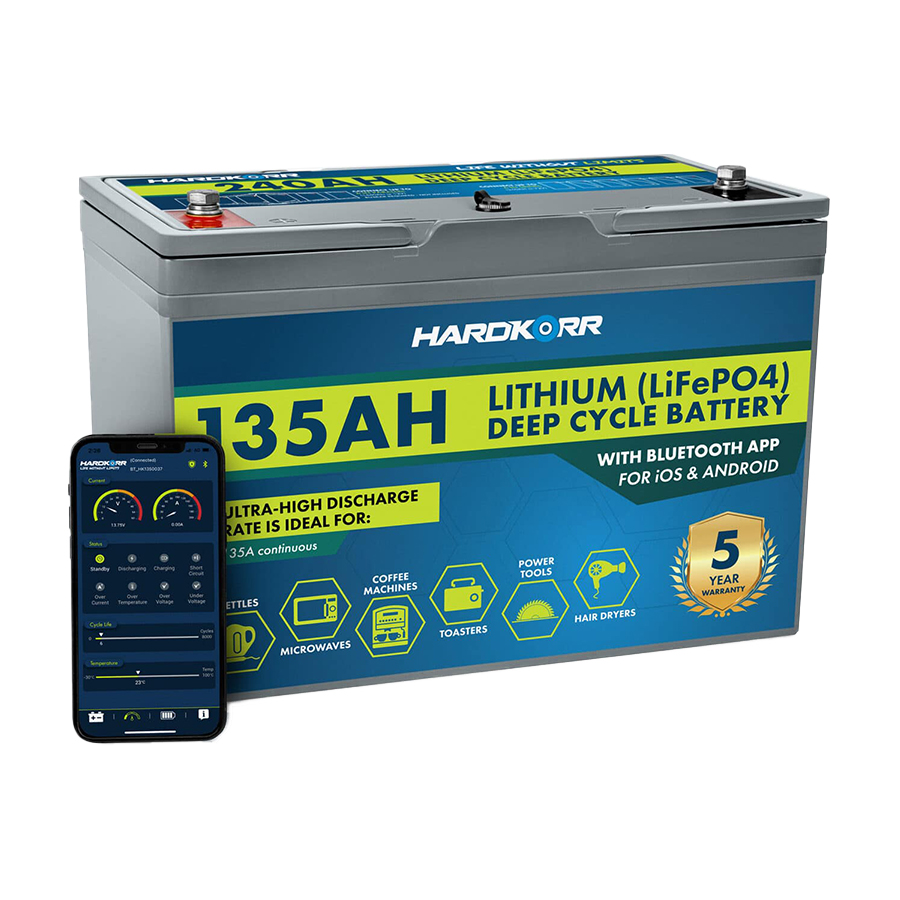
 Hardkorr 12V 135AH LIFePO4 Battery W/ Bluetooth


Description
Latest technology, highest quality.
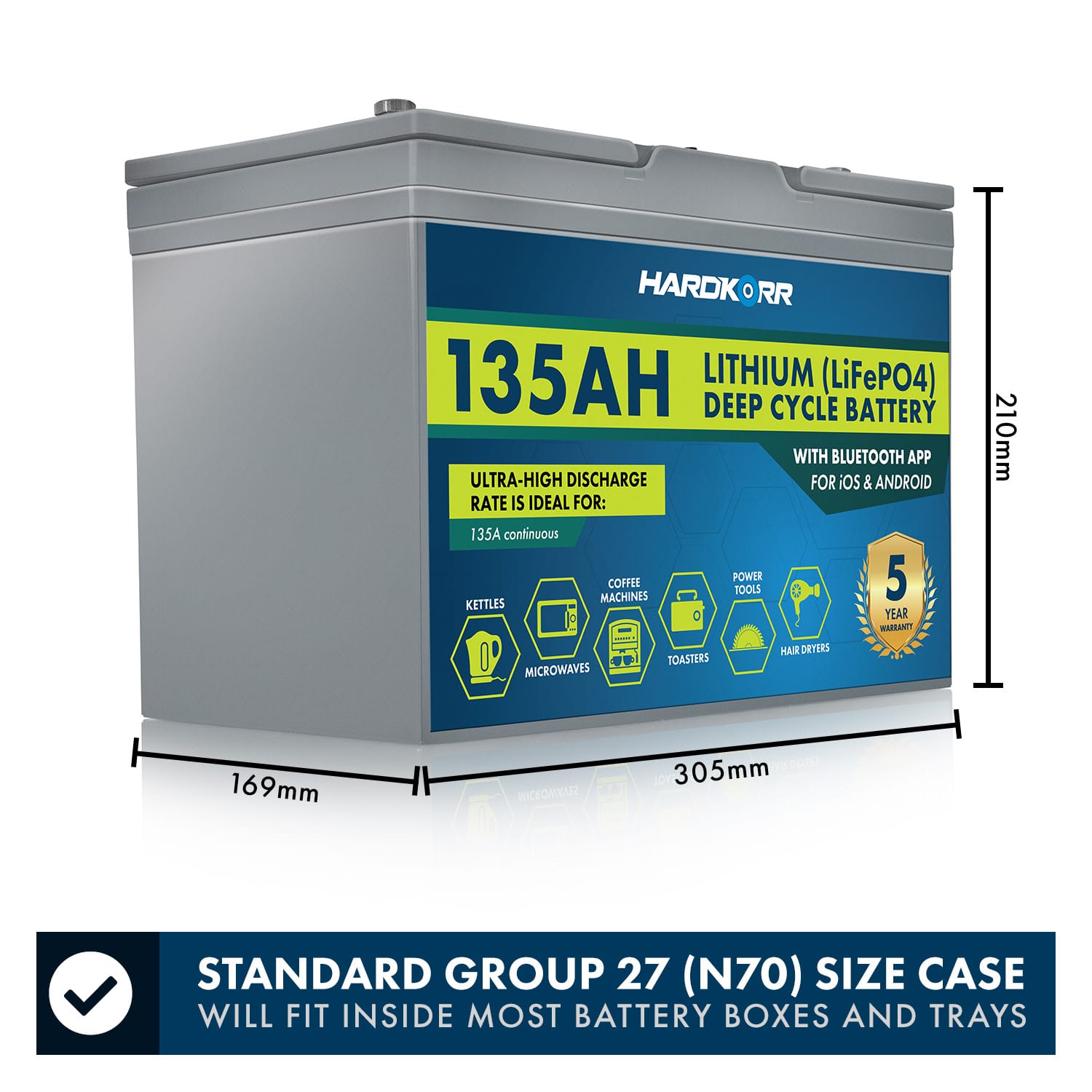
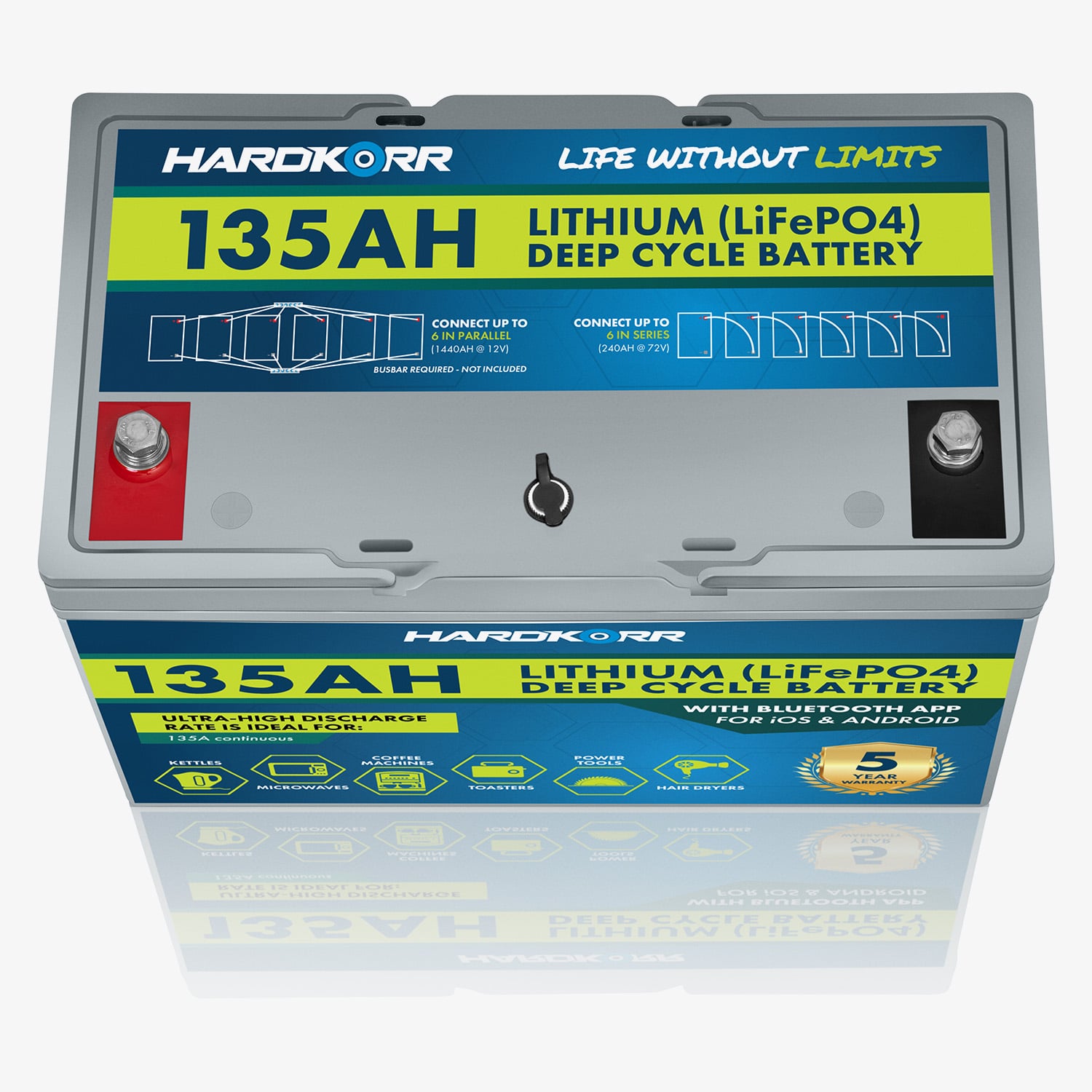
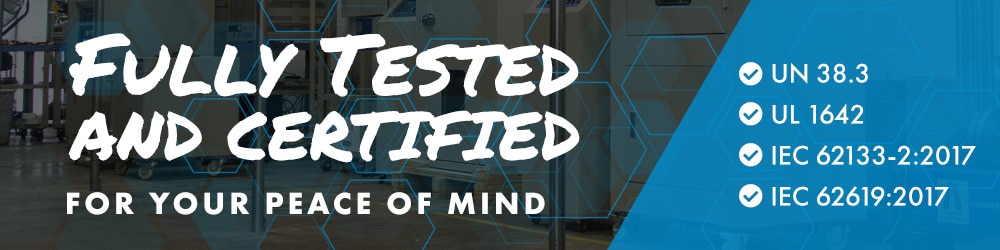
Our latest range of 135Ah lithium (LiFePO4) deep-cycle batteries are the most reliable, technologically-advanced batteries we have ever manufactured. With Bluetooth® monitoring, outstanding performance characteristics and full international certification, you’ll never be caught short of 12v power on your 4wding and camping adventures again! Best of all, we’ve packed 135Ah of usable power into a standard Group 27 (N70) size case, meaning they are compatible with standard-sized battery boxes and trays.
These batteries are made using best-in-class robotic manufacturing processes with rigorous quality assurance (including serialised tracking) and pre-shipment cycle testing. We even store the test report for each battery for later reference if needed. That’s why we can now confidently offer you a 5-year Australian warranty.
Top-quality cells
Our 135AH deep-cycle lithium batteries are constructed from the highest quality 26700 high-discharge cylindrical cells. The cells are carefully matched to ensure the difference in internal resistance is less than 1mΩ and voltage difference is less than 5mV. They are then ultrasonically welded using automated equipment to ensure a strong connection is made between each cell, and encased in custom-molded ABS plastic cell holders to ensure reliability and consistency even when subjected to shock and vibration.
Wait… aren’t prismatic cells better?
Prismatic and cylindrical cells both have inherent advantages and disadvantages. Batteries which use prismatic cells are somewhat lighter than those with cylindrical cells, and are easier to manufacture due to having fewer connections between cells. Cylindrical cells, on the other hand, are usually more efficient in their energy usage, produce somewhat less heat and tend to be more reliable than their prismatic counterparts.
The improved cell reliability and efficiency of cylindrical cells are what made us decide, like Tesla and Rivian, to manufacture these batteries from cylindrical cells.
More usable power, longer life
When comparing batteries it is vitally important to understand the difference between nominal and C20 capacity. To reduce confusion and help to standardise the measurement of battery capacity, most reputable battery manufacturers will quote the capacity of their battery in amp-hours at C20 (also written as C/20), which means the number of amps the battery can deliver if discharged at a constant rate over a period of 20 hours. Using this standard, a fully-charged battery with a capacity of 100Ah could deliver 5A of current per hour for a period of 20 hours before becoming fully discharged (5A x 20h).
Some disreputable manufacturers, however, will advertise the nominal capacity of their batteries and bury the C20 rating in the fine print. Nominal capacity has no practical application and can be up to 20% higher than the C20 rating, so a battery that is advertised as a 120Ah battery might only be able to deliver 105Ah or even less.
We value our good reputation, and will always quote the C20 rating as the battery’s capacity. This means you can be confident that the power we say our batteries can deliver is not inflated to mislead, create confusion or invite unfair comparisons.
Bluetooth® monitoring app
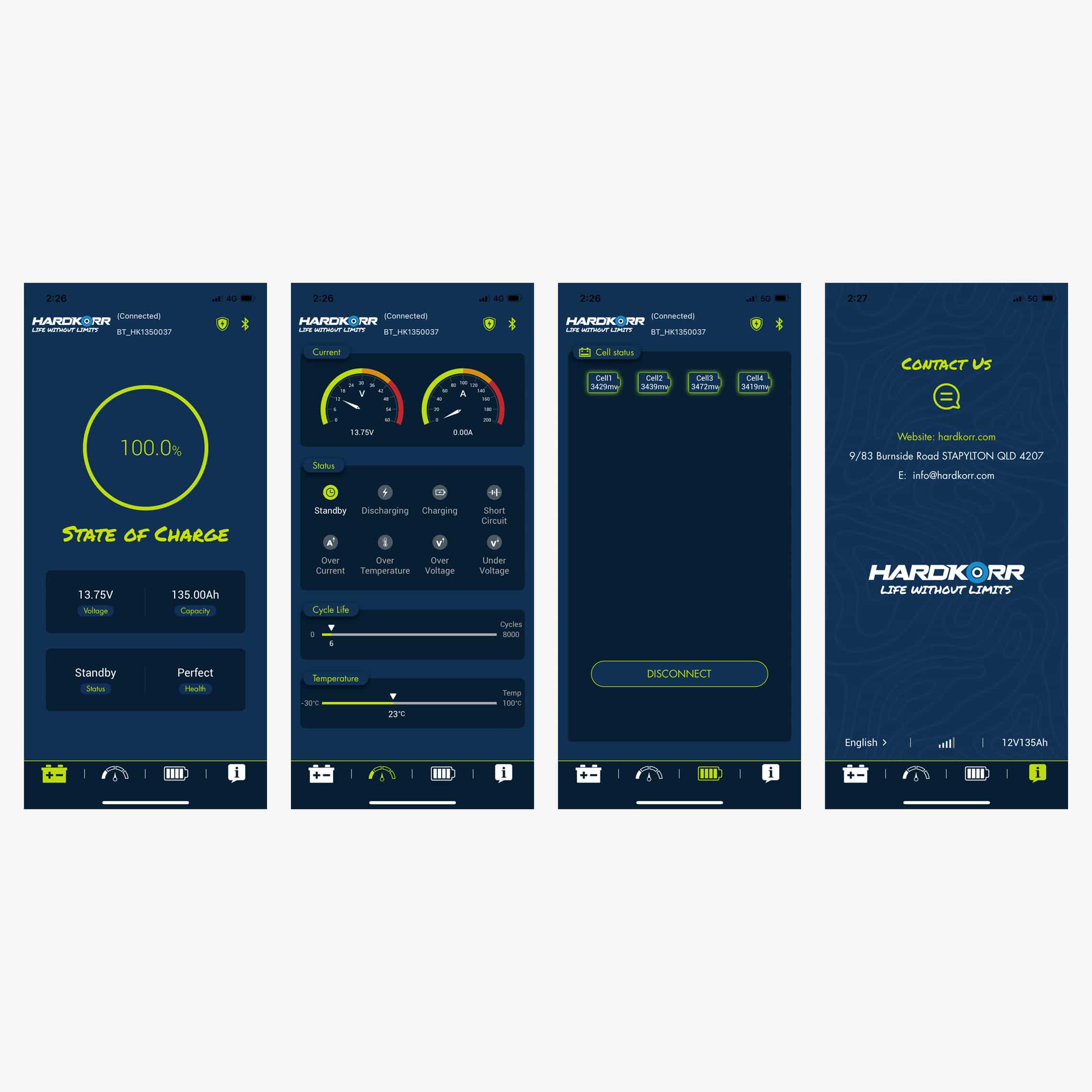
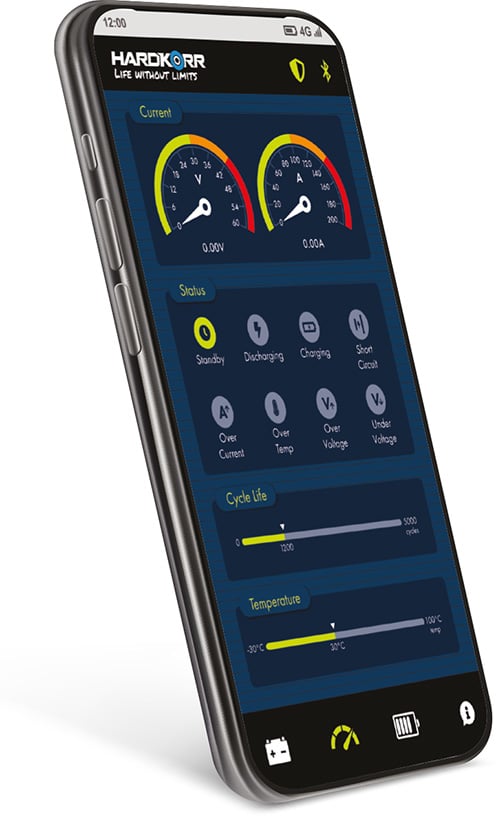
This battery give you the capability to easily monitor its key data wirelessly, via Bluetooth® connection. You can access this feature by downloading the Hardkorr Battery app which is available for iOS® and Android® devices. With the app you can view:
-
KEY INFORMATION
State of charge, current voltage, available capacity, status, health.
-
DETAILED INFORMATION
Current voltage, net current in/out, status, cycle life, temperature.
-
CELL STATUS
Current voltage of each cell to ensure they are balanced.
-
CONTACT DETAILS
Why upgrade to lithium?
- Long cycle life: lasts up to 10x longer than Sealed Lead Acid (SLA) batteries
- More usable capacity: safely use up to 70% of usable capacity and 99% in an emergency (vs 50%/70% for SLA)
- Light weight: About half the weight of an equivalent SLA battery
- Environmentally friendly: Non-toxic, contains no acid, can be installed in any direction
Handy remote reset switch
The Battery Management System (BMS) inside all lithium batteries contains a protection circuit which trips if the voltage drops below a certain setpoint. In the case of Hardkorr batteries, it is set at 10.0V. This circuit prevents damage to the battery by putting it into a ‘sleep’ mode until it is reset.
In the past, resetting the battery after the over-discharge protection was activated was not easy. Whilst some battery chargers do contain a “wake-up” function, most people had to resort to applying a constant voltage above 12V across the terminals using jumper leads or home-made wires. This was fraught with danger; damage to appliances or the battery were not uncommon.
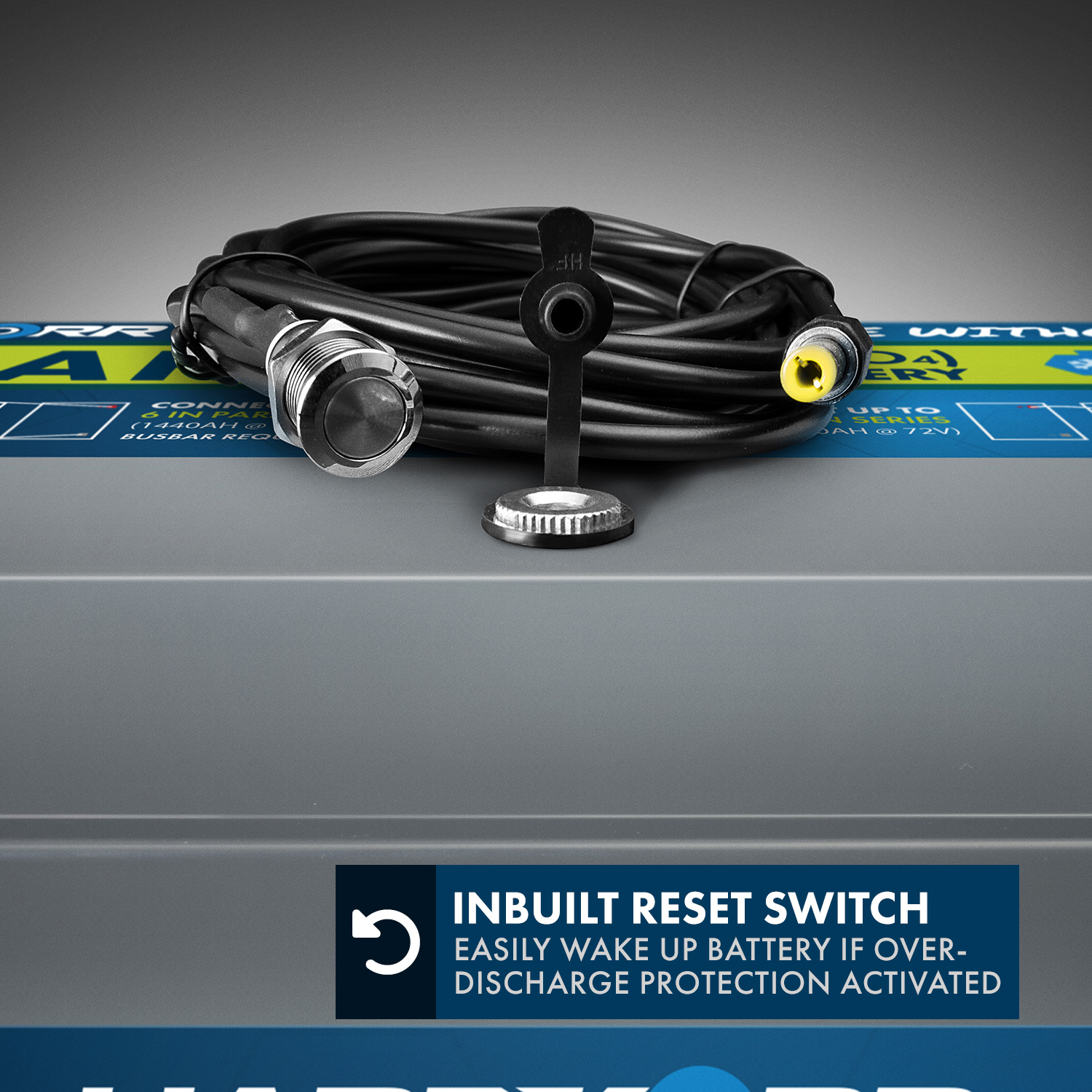
Our batteries provide an easy solution to this problem; simply connect our included remote reset switch to the socket on the top face of the battery and hold down the button for 5 seconds, and the over-discharge circuit will reset itself. The button can also be flush-mounted into your 12v setup if desired.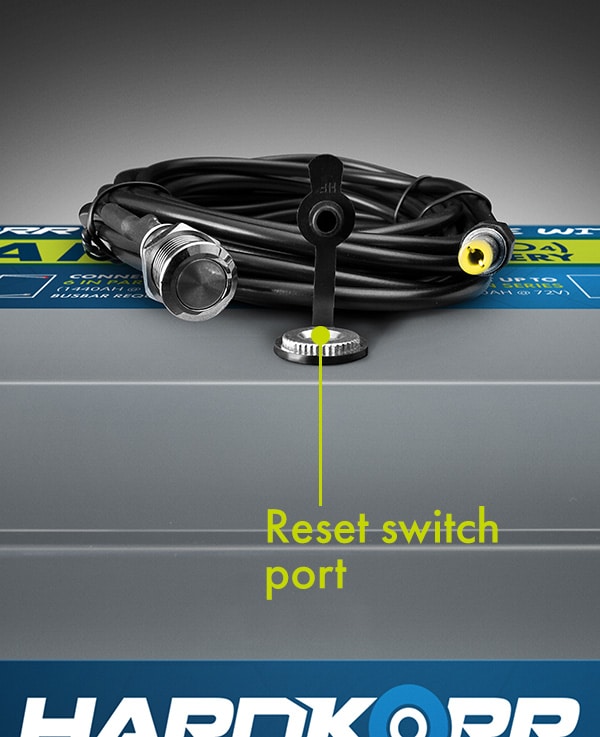
Specifications
| Nominal voltage | 12.8V |
|---|---|
| Capacity (C20) | 135Ah |
| Max series/parallel config | 6S/6P |
| Normal charge voltage | 14.4V ± 0.2V |
| Standard / fast charge current | 27A / 67A |
| Max discharge current (constant) | 135A (1C)* |
| Max discharge current (pulse) | 600A* |
| Discharge cut-off voltage | 10.0V |
| Charge temp | 0°C to 55°C |
| Discharge temp | -20°C to 60°C |
| Storage temp | -5°C to 45°C |
| Ingress protection | IP64 |
| Self-discharge | <3% per month |
| Weight | 14.0kg |
| Dimensions | 305mm x 169mm x 210mm (Group 27) |
| Certifications | UN 38.3, UL 1642, IEC 62133-2:2017, IEC 62619:2017, CE |
* Note on discharge current: if you connect multiple batteries in parallel, the maximum discharge current is multiplied by the number of batteries in the array. For example, if you connect two of these batteries in parallel you can discharge at up to 270A.
Latest technology, highest quality.
Our latest range of 135Ah lithium (LiFePO4) deep-cycle batteries are the most reliable, technologically-advanced batteries we have ever manufactured. With Bluetooth® monitoring, outstanding performance characteristics and full international certification, you’ll never be caught short of 12v power on your 4wding and camping adventures again! Best of all, we’ve packed 135Ah of usable power into a standard Group 27 (N70) size case, meaning they are compatible with standard-sized battery boxes and trays.
These batteries are made using best-in-class robotic manufacturing processes with rigorous quality assurance (including serialised tracking) and pre-shipment cycle testing. We even store the test report for each battery for later reference if needed. That’s why we can now confidently offer you a 5-year Australian warranty.
Top-quality cells
Our 135AH deep-cycle lithium batteries are constructed from the highest quality 26700 high-discharge cylindrical cells. The cells are carefully matched to ensure the difference in internal resistance is less than 1mΩ and voltage difference is less than 5mV. They are then ultrasonically welded using automated equipment to ensure a strong connection is made between each cell, and encased in custom-molded ABS plastic cell holders to ensure reliability and consistency even when subjected to shock and vibration.
Wait… aren’t prismatic cells better?
Prismatic and cylindrical cells both have inherent advantages and disadvantages. Batteries which use prismatic cells are somewhat lighter than those with cylindrical cells, and are easier to manufacture due to having fewer connections between cells. Cylindrical cells, on the other hand, are usually more efficient in their energy usage, produce somewhat less heat and tend to be more reliable than their prismatic counterparts.
The improved cell reliability and efficiency of cylindrical cells are what made us decide, like Tesla and Rivian, to manufacture these batteries from cylindrical cells.
More usable power, longer life
When comparing batteries it is vitally important to understand the difference between nominal and C20 capacity. To reduce confusion and help to standardise the measurement of battery capacity, most reputable battery manufacturers will quote the capacity of their battery in amp-hours at C20 (also written as C/20), which means the number of amps the battery can deliver if discharged at a constant rate over a period of 20 hours. Using this standard, a fully-charged battery with a capacity of 100Ah could deliver 5A of current per hour for a period of 20 hours before becoming fully discharged (5A x 20h).
Some disreputable manufacturers, however, will advertise the nominal capacity of their batteries and bury the C20 rating in the fine print. Nominal capacity has no practical application and can be up to 20% higher than the C20 rating, so a battery that is advertised as a 120Ah battery might only be able to deliver 105Ah or even less.
We value our good reputation, and will always quote the C20 rating as the battery’s capacity. This means you can be confident that the power we say our batteries can deliver is not inflated to mislead, create confusion or invite unfair comparisons.
Bluetooth® monitoring app
This battery give you the capability to easily monitor its key data wirelessly, via Bluetooth® connection. You can access this feature by downloading the Hardkorr Battery app which is available for iOS® and Android® devices. With the app you can view:
-
KEY INFORMATION
State of charge, current voltage, available capacity, status, health.
-
DETAILED INFORMATION
Current voltage, net current in/out, status, cycle life, temperature.
-
CELL STATUS
Current voltage of each cell to ensure they are balanced.
-
CONTACT DETAILS
Why upgrade to lithium?
- Long cycle life: lasts up to 10x longer than Sealed Lead Acid (SLA) batteries
- More usable capacity: safely use up to 70% of usable capacity and 99% in an emergency (vs 50%/70% for SLA)
- Light weight: About half the weight of an equivalent SLA battery
- Environmentally friendly: Non-toxic, contains no acid, can be installed in any direction
Handy remote reset switch
The Battery Management System (BMS) inside all lithium batteries contains a protection circuit which trips if the voltage drops below a certain setpoint. In the case of Hardkorr batteries, it is set at 10.0V. This circuit prevents damage to the battery by putting it into a ‘sleep’ mode until it is reset.
In the past, resetting the battery after the over-discharge protection was activated was not easy. Whilst some battery chargers do contain a “wake-up” function, most people had to resort to applying a constant voltage above 12V across the terminals using jumper leads or home-made wires. This was fraught with danger; damage to appliances or the battery were not uncommon.
Our batteries provide an easy solution to this problem; simply connect our included remote reset switch to the socket on the top face of the battery and hold down the button for 5 seconds, and the over-discharge circuit will reset itself. The button can also be flush-mounted into your 12v setup if desired.